AI Video Creatives in 2026: The Full Pipeline, the Models That Matter, and the New Rules for Media Buyers
Building a talking, emoting spokesperson for your ads from scratch — from a photo pulled off the internet to a finished clip. With real prices, a breakdown of the newest models, and the legal nuances that turned critical this year.
Six months ago, "AI video" was, for most buyers, an experiment for the Telegram channel. Today it's a working part of production: teams run dozens of hypotheses a week without a film crew, actors, or an editor. The models have grown up enough that the average viewer scrolling a feed can't reliably tell a synthetic presenter from a real one — at least not in the first few seconds, which is exactly where the click is won or lost.
We decided to rerun the old experiment under new conditions. We take two top-performing creatives that consistently show up in spy tools: the first is the "podcast" format, where a recognizable speaker calmly talks about a game straight to camera; the second is an emotional scene where the heroine reacts wildly to a big win while the people around her cheer her on. We reproduce both entirely with neural networks — no live gameplay, no editing — to show the pipeline in its purest form.
As before, instead of the original characters we'll use a stand-in celebrity — let's call her "our heroine." Why we don't take a real, specific actor's face seriously will become clear by the compliance section. In 2026 that's no longer abstract "caution" — it's concrete fines.
Why the Approach Matters More Than the Model
The classic rookie mistake is chasing "the single best model." In this field the best model lives a month or two before something overtakes it. Everything we mention below — Nano Banana, Kling, Seedance, Veo, Hailuo — is the top of the market right now, but by the time you read this the leaderboard may already have shifted. So treat this piece not as a click-by-click manual, but as a set of principles that will outlive any update.
There's really only one key principle: move from cheap to expensive. An image costs pennies, and sometimes generates for free. Video costs tens of times more. So you first perfect the static frame — check that the character matches the intended look, that there are no extra fingers, warped geometry, or artifacts — and only then spend credits animating it. Anyone who generates video straight from scratch, blind, burns budget on failed takes with no guarantee of a result.
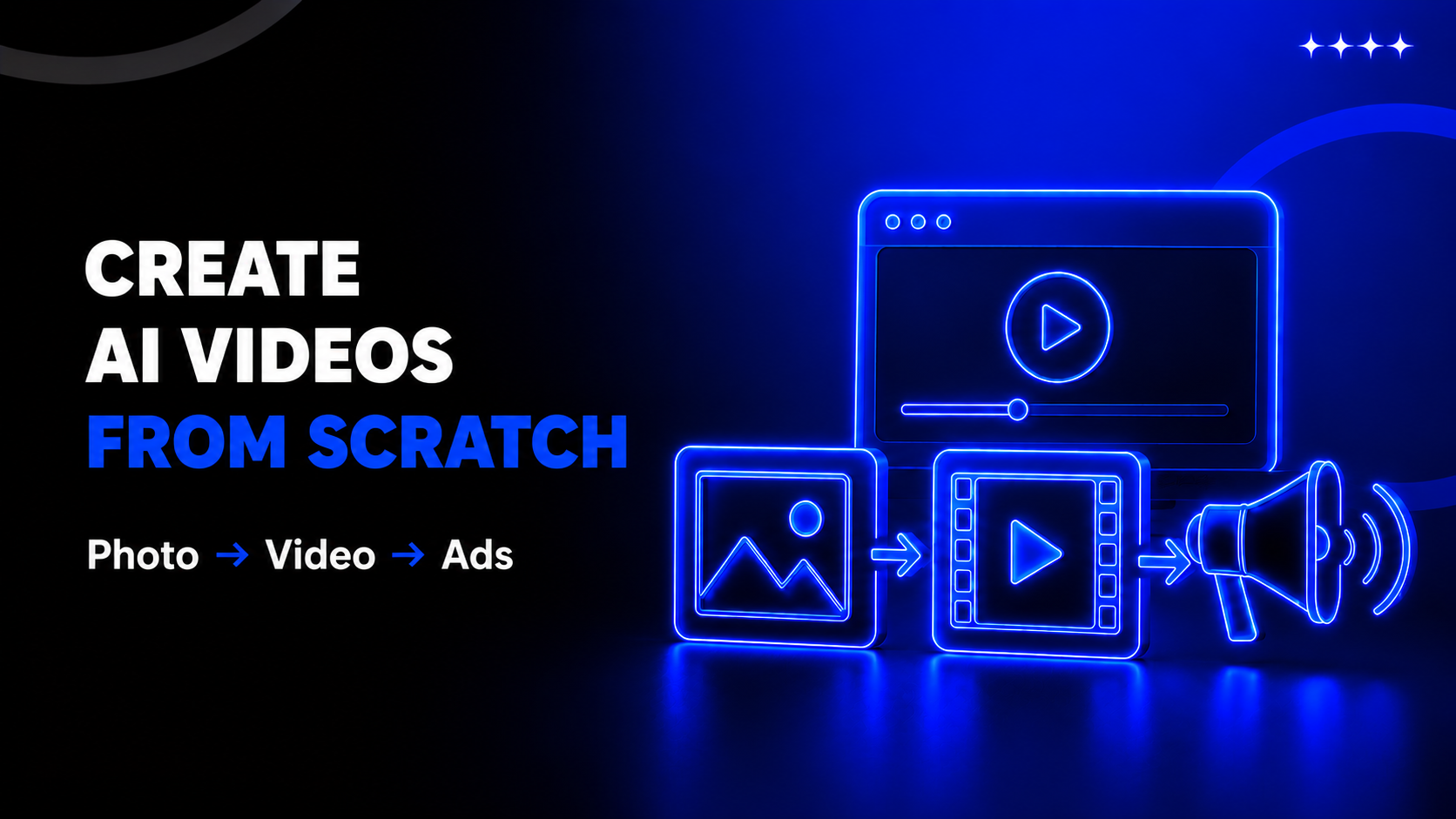
That's where the whole pipeline logic comes from: photo as a reference → audio → animate into video. At every stage there are forks where you can cut costs several times over without losing quality. Let's walk through them in order.
The 2026 Toolkit: Aggregator or a Custom API Pipeline
To get a talking person on screen you need to solve three tasks: generate the image, get an audio track, and assemble it into a video with lip-sync. Each has its own specialist models, and here's the first fork — go through an aggregator, or build a pipeline from separate services via API.
An aggregator is a platform where dozens of models sit under one roof with a shared balance and a single interface. Among the popular ones right now: Higgsfield and Google Flow. Under the hood they run the same engines, so at equal settings the quality comes out nearly identical. The upside is obvious: no jumping between a dozen tabs, no registering for each service, no wrangling separate billing. For testing, demos, and modest volumes it's the ideal low-barrier entry point.
Building on API is the path for teams with a budget, a steady flow of creatives, and at least one developer. Access to an image generator (the same Nano Banana) comes through OpenRouter or directly via Google's API, and you pay per generation rather than a monthly subscription with limits. Video gets run through aggregators like fal.ai or Replicate — hundreds of models are reachable with the same request, and at high volume this is noticeably cheaper than paying an aggregator's markup for convenience.
The rule is simple: if the task is to understand what each model can do, start with an aggregator. Once volume grows and you know which two or three models you actually use in production, then it makes sense to run the numbers on your own API pipeline.
Step One: The Reference Photo
Start with the image. Find a suitable photo of the look you want — on Google, Pinterest, or any other source — drop it into the image generator, and ask it to recreate the same person but in the setting you need. For a podcast creative that's a studio interior with a mic and soft light; for a "big win" creative, a casino, a slots hall, or a home setting with a laptop.
As the image model, Google's Nano Banana line currently holds the lead — it keeps a face consistent, handles detail cleanly, and rarely breaks anatomy. An important note on resolution: on many aggregators, generation at 1K and 2K costs the same, the only difference is processing time. But 4K is usually double the price, and it's worth enabling deliberately. Keep in mind that the final video renders at 720–1080p anyway, so chasing 4K at the source-photo stage is usually pointless — you're paying for resolution nobody will ever see.
And calibrate one expectation up front: not every generation will land. The same prompt sometimes has to run three to five times before a clean frame comes together without glitches. That's normal and baked into the mechanics. This is exactly why the photo is done first — at the cheapest stage, where failed takes cost almost nothing.
Step Two: Bringing It to Life with Lip-Sync and Avatars
The finished frame becomes the first frame of the future video. Next comes lip-sync. The job here is to make a static face speak, syncing lip movement to an audio track. Among the workhorses of mid-2026, that's models like Kling Avatars: load a photo and audio, and you get a talking character.
Here hides the second major cost fork, and it isn't about the model — it's about the quality selector. Lip-sync is priced at roughly one credit per second of audio: a 17–18-second clip at standard 720p runs about eighteen credits. Flip the quality to high 1080p and the price of the same clip nearly doubles. For a creative living in a feed on a phone, the quality difference is barely visible to the eye, while on the balance sheet it's a doubling of budget on every take.
Hence the working rule: if you genuinely need high quality, first assemble the clip in low, confirm the model does exactly what you asked — the right expressions, the right angle, no stray subtitles — and only then regenerate the final version in high. That way you don't burn expensive credits testing hypotheses you could have tested cheaply.
On subtitles, by the way: models love adding them on their own initiative, even when you didn't ask. If you don't want subtitles, say so in the prompt in plain text. In general, keep the lip-sync prompt as simple as possible — "a woman speaking to camera" works better than a paragraph of artistic description, because the model starts interpreting the extra detail its own way.
Working with Sound: Voices and Cloning
There are three scenarios for audio. If you already have a live voice recorded — use it, it always gives the most natural result. If not, take one of the ready-made preset voices or generate a synthetic one through engines like ElevenLabs, which long ago crossed the "robotic" threshold and now sound like living speech with intonation and pauses.
Separately, about swapping the voice in an already-finished video. Say the lip-sync came out great but the voice didn't fit the look. You don't need to redo the expensive lip-sync — many aggregators let you replace just the audio track in the final clip for a token one and a half to two credits. For that money you can cycle through twenty voiceover options, dialing in the perfect sound for a geo and offer, without touching the video.
Voice cloning is technically easy too: take a few minutes of clean speech from the person you want, train a model on it in a couple of clicks, and it will then say any text of yours in that voice. This is exactly where the gray zone begins. Cloning the voice of a real public figure without their consent for advertising in 2026 is a direct route into right-of-publicity and voice claims, which we'll cover in detail in the compliance section. For a synthetic character who doesn't exist, the problem disappears: you clone a voice you generated yourself.
Whole or in Pieces: How to Beat Limits and Not Overpay
We assembled our podcast clip whole — all 17–18 seconds in one continuous line. But that isn't always the right move, and understanding this saves both money and nerves.
The logic is simple. If the character is on screen from start to finish, generate the video as one piece. If, per the script, they only appear at the beginning and end while the middle is gameplay or other content, generate two short fragments separately, each cut precisely to the lines you need. You'll replace the middle anyway — so why pay to generate it?
This trick has a second, less obvious benefit — it removes the length limit. Some avatar models handle clips up to several minutes, but most video models cap out at 10–15 seconds per generation. By breaking a long clip into short fragments and stitching them together, you get access to any model without hitting its ceiling, and you can mix and match: make one segment on one model, another on a different one, if their strengths differ.
The Second Creative Type: Emotion and Reaction
The second creative works a bit differently. There's no talking head here — there's a scene: the heroine reacts wildly to a win, people around her celebrate, someone films it on a phone. These creatives grab attention not with text but with raw emotion, so they're built differently.
A handy trick is to not write the prompt by hand but hand it to a text model. Send a chat model a screenshot of the original creative from a spy tool, describe the scene in words — the heroine won a large sum, jubilation all around — and ask it to build a detailed prompt for generating a similar frame with your character. You send that prompt along with the photo into the image generator. The model produces a frame of the winning heroine, and then you hit "animate" right in the interface and move to video.
Keep the video prompt simple again: "the heroine is overwhelmed with emotion from the win, people around her cheer her on, a man films it on a phone." And this is where it gets interesting — different models understand the same task differently.
We ran the same frame through two models. Kling produced a restrained, clean scene exactly to brief: heroine, emotion, support from the crowd — nothing extra. Ten seconds at 720p cost around twenty credits. Grok Imagine went further and added its own flourishes — inserted dialogue, mentions of the win amount, far more dynamic direction. Formally that isn't what we asked for: Grok in general tends to embellish a scene and almost always insists on adding speech, even when it wasn't asked to. But the frames still came out surprisingly alive and perfectly usable for a separate creative. The takeaway for a buyer: don't marry one model. Run one frame through two or three and take the version that best fits the specific offer — it costs pennies, and the variety on the output is free.
The Video-Model Landscape in Mid-2026
A year ago the market had two or three viable players. Now there are more than a dozen frontier models, and — importantly for reading the trend — the top of the leaderboards for video-with-audio generation is held by Chinese engines. Resolution stopped being a differentiator: almost every serious model already outputs native 1080p or 4K. The competition has shifted toward synchronized audio, reference handling, and holding a scene consistent across shots.
The short version of the mid-2026 standings looks like this. Kling in its current version is the price-to-quality champion: native 4K, solid multilingual lip-sync, the lowest cost per second among premium models. That's exactly why it became the workhorse for high volume. Google's Veo is the safest pick for anyone who values a cinematic result and genuinely synchronized audio with full speech rather than just effects; the price is higher, so it makes sense to reserve it for "hero" clips. ByteDance's Seedance has cemented itself at the top and is strong in long image-to-video scenarios. Hailuo, Wan, and Runway occupy their niches: Wan is interesting as an open and nearly free model, Runway for the best control over a scene, Hailuo for its balance of speed and quality.
Worth keeping in mind separately is the fate of OpenAI's Sora. The public app and web version were shut down back in spring, and API access is being turned off in the fall of 2026. Building a new pipeline on Sora right now means planting a time bomb under it. If you happen to be tied to it, it makes sense to plan the migration to another model in advance, while the API is still alive.
Once more, to underline what we opened with: specific versions will age out. What matters isn't the model's name but the habit of keeping a finger on the pulse, running the same frame through several engines, and picking per task.
The Economics: What It Actually Costs
Now for the money, in concrete numbers. Our entire experiment — two creatives, repeat generations, tests of different models, and all the failed takes — came in at roughly 150 credits. A plan for a thousand credits costs about fifty dollars, meaning two finished creatives ran about seven and a half dollars.
For a sense of the price scale: lip-sync for 17–18 seconds is about eighteen credits, ten seconds of video on Kling is roughly twenty, a voice swap is one and a half to two. When you move to API providers, the math is counted in seconds of generation instead: premium models live in a range of roughly ten to forty cents per second of video, while the cheapest open engines drop toward five cents. At scale, that gap between "convenient aggregator" and "your own pipeline" turns into meaningful monthly sums.
But for a media buyer, what matters isn't the price of one clip — it's the unit economics of the creative. Think of it this way: if one synthetic clip costs you a notional four dollars, and a live shoot of the same idea costs several hundred, then neural networks let you test not one hypothesis but twenty for the same money that one live clip would have eaten. Then you take the winner and either reshoot it live for scale or invest in an expensive generation. The point isn't to replace live production — it's to cheaply cull twenty bad ideas before real money is spent on them.
Automation: API, MCP, and Agents
Everything we did by hand, switching between tabs, is in 2026 almost fully automatable. Many services expose not only an API but an MCP server — a layer you can connect straight to your working AI assistant like ChatGPT, Claude, or Gemini. After that, you don't press the buttons yourself; you simply tell the assistant, "generate a podcast clip with such-and-such character, this text, in this interior," and it goes to the right models through MCP on its own, assembles the photo, voiceover, and video, and hands back a finished file.
For a team producing creatives in batches, this changes how the work is organized. The pipeline is described once, and then the conveyor churns out variations: the same scene for ten different geos, ten different offers, ten different opening seconds. The human in this setup handles briefs and selection, not clicking. Don't start here — first you need to figure out by hand which models and settings deliver the result you want — but once the pipeline settles, automation pays for itself almost immediately.
The New Reality of 2026: Compliance, Disclaimers, and the Right to Likeness
And now the section that wasn't in last year's guides at all, but that this year became more important than any technical nuance. While buyers were learning to generate faces, regulators were learning to fine them for it — and in 2026 they caught up.
The headline event is the entry into force of AI-content transparency requirements in the European Union. Starting in early August 2026, any synthetic clip that reaches a European audience must, first, carry a disclosure visible to a human that the content is AI-generated and, second, bear machine-readable marking — a watermark of a standard like C2PA or SynthID, embedded in the file itself. The definition of a "deepfake" in the regulation is deliberately broad: it covers not only a copy of a real person but any realistic synthetic presenter, an avatar "testimonial," and a synthetic voiceover that sounds like living speech. Which is exactly what we spent this whole guide building. The fines reach up to fifteen million euros or a percentage of global turnover, and the obligation sits not only with the model's developer but with whoever publishes the creative.
The US states are taking their own road, but in the same direction. In New York, from the summer of 2026, a synthetic-performer disclosure law is in effect: any ad with an AI-generated human likeness requires a conspicuous disclosure, and repeat violations are fined separately for each instance. And that's the rule for invented characters. For a copy of a specific, named celebrity, a separate and stricter provision on the right to likeness and voice applies — using a recognizable face or voice of a real person in advertising without consent is now a direct legal risk, and "but it's just a neural network" doesn't hold: if a viewer reasonably believes a real person is endorsing something, consent and payment are presumed to be required.
What follows for practice. First: a synthetic character who doesn't exist in nature is incomparably safer, legally, than a copy of a real star. That's precisely why in this article we deliberately don't take a specific actor's face seriously — only as a conditional example to explain the mechanics. Second: the infrastructure for disclaimers and watermarks needs to appear in your process before, not after, the first letter from a regulator.
Major models already embed C2PA and SynthID on their side, but the combination of "visible disclaimer plus metadata" is the responsibility of whoever publishes the ad. The gap here is at the buyer level, not the model level. In gambling and betting, where advertising is already under a magnifying glass, ignoring this means collecting bans and fines for no reason at all.
Why "Adult" and Aggressive Content Is Still Hard
The "18+" topic gets skirted, yet questions about it never stop, so let's be blunt: censorship has won on public models. The difficulties start as early as a photo in revealing clothing, and for video there simply are no accessible tools for anything remotely suggestive — the mainstream engines cut it off at the root.
For full "adult" content you have to move to fundamentally different models, and the price there is quality. Plastic faces, unnatural bodies, anatomy that doesn't add up, and old artifacts like extra fingers surface far more often. The same goes for aggressive "shock" mechanics, which models block under their own policies. Technically you can work around it, but you're trading a clean picture for a dubious one — and taking on all the risks from the previous section, doubled. A sober calculation usually leads to the conclusion that the juice isn't worth the squeeze, at least on public tools.
Speed and Volume: The Real Lever
If you boil the entire advantage of AI content down to one phrase, it's the ability to make it fast and in bulk. Even when the quality doesn't yet reach live footage, you get something live production physically cannot give: cheap validation of hypotheses at industrial scale.
The working scheme looks like this. You run ten creative variants on neural nets — different opening seconds, different emotions, different hooks — push them into a test, find the winner, and only then invest in that one specifically: either by reshooting it with real people or with a more expensive, higher-quality generation. That's several times faster and cheaper than shooting every idea live and realizing on the fifth that only the second one lands. Here, neural networks aren't a replacement for your creativity — they're a way to fail cheaply.
The Bottom Line
We walked the full path — from a photo off the internet to two finished clips with a talking, emoting character — and spent about seven and a half dollars on it, failed takes included. But what's worth taking away isn't the specific models or the exact credit counts: both will be outdated by next quarter.
What's worth taking away is the approach. First a cheap photo as a reference, then sound, then video. Test at low quality, regenerate at high only what definitely worked. Break long clips into short fragments to save money and dodge model limits. Run one frame through several engines and take the best. And on top of all of it — mandatory from 2026 on — layer disclaimers, watermarks, and common sense about other people's faces and voices.
These principles will outlive any neural-network update. And updates are coming — very soon.
Share this article
Send it to your audience or copy an AI-ready prompt.