Google Ads Bans in 2026: Why Accounts Get Suspended — and How to Prevent It
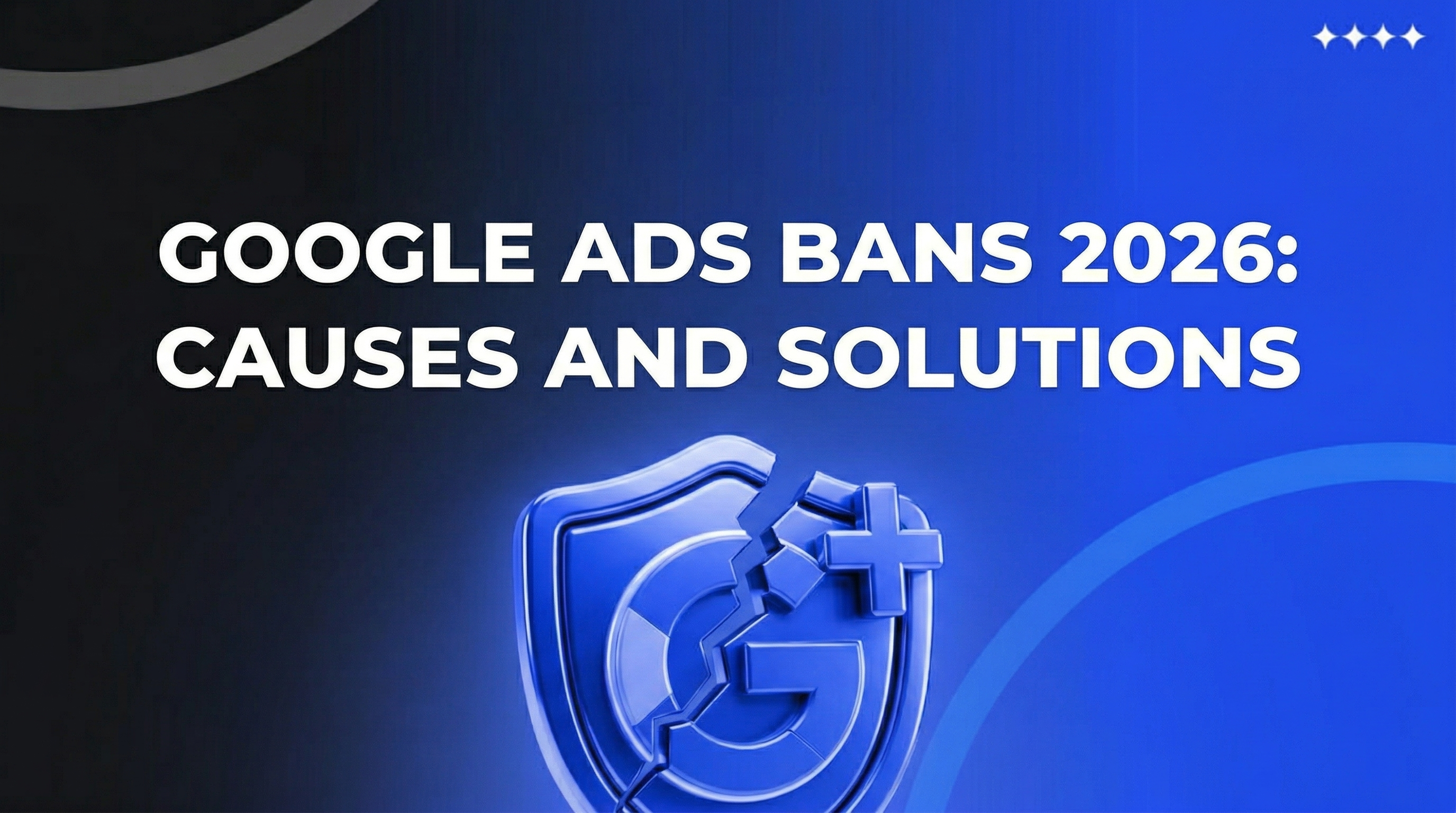
Your account gets suspended even before the first launch. The card is added — and two days later, it’s banned. A new account survives exactly as long as it takes the algorithm to identify it. If this sounds like your daily reality, welcome to 2026.
Google has significantly changed its moderation approach this year. Not the rules — those remain largely the same. But the logic of evaluation. Now the system doesn’t look at individual ads; it looks at the full picture: who you are, how you pay, how you behave inside the ecosystem, and how your entire structure is connected. Let’s break it down.
How Google sees your advertising structure
For Google Ads, you are not just an ad account. You are a full hierarchy: personal Google account, billing profile, ad account, manager account, domains. The algorithm evaluates everything in connection, not in isolation.
The personal Google account is the foundation. When you first try to run ads, the system checks when the account was created, whether there is any activity in Gmail, YouTube, or Search. A fresh account with no history immediately has a lower trust level. Not a ban — but it will be monitored more closely than a two-year-old account.
The billing profile is a separate layer. It contains payer details: name, country, address, payment method. For Google, consistency is critical. If the account is registered in Germany, the ads target German users, but the card is issued in a completely different region — the system notices this mismatch and starts investigating. Sometimes it leads to limited delivery, sometimes to a full suspension.
The manager account (MCC) creates an illusion of isolation. It feels like each ad account operates independently. But Google sees the entire structure. If one account inside the MCC behaves suspiciously — for example, runs a risky offer or violates policy — the system starts reviewing all other accounts within that structure. One problematic launch can pull down completely clean projects.
This is known as the domino effect, and in 2026 it has become significantly more common.
Attempts to bypass the system: what Google sees and how it reacts
Any attempt to hide real data or mask content is treated as a red flag. A classic example is cloaking: moderators see a clean landing page, while real users are redirected elsewhere. Google explicitly prohibits this and bans accounts without warning when detected.
Another common scenario is creating a new account after a ban. The logic is simple: the old one is gone, so we start fresh. But the system analyzes patterns: domains, payment data, login devices, behavioral signals. If the algorithm recognizes familiar fingerprints, the new account can be banned even before the first campaign starts.
Domains are another key factor. If a website has already been flagged in a banned account for serious violations, it carries negative reputation. Even if the new ad is technically compliant, the system evaluates the history of the entire infrastructure, not just the current creative.
Appeals in such cases are rarely effective. After repeated or clear violations, rebuilding the infrastructure from scratch is often more efficient than waiting for reinstatement.
Billing profile: where most launches fail
Payment-related issues are the leading cause of bans in 2026. And it’s not always about a “bad card” — it’s about how it fits into the overall pattern.
Google evaluates consistency: account country, billing details, card region. If everything aligns logically, there are fewer issues. If a German account is funded with a card from a different region under a different payer identity, the system flags it immediately.
Virtual cards are a separate risk category. If a BIN range has accumulated chargebacks or suspicious activity, the entire pool becomes high-risk. The first payment may go through, but the ban arrives days later, after the system finishes analyzing billing behavior.
Chargebacks are especially critical. After one, an account is almost always disabled, and the billing profile receives a negative mark that carries over to future setups. If a card already has disputes in its history, it should not be reused in new accounts.
Manager accounts: one mistake affects the whole structure
An MCC (Manager Account) gives the impression that each account lives in isolation. This is misleading. Google treats the entire structure as one entity and reacts accordingly.
If a risky offer is launched in one account inside the MCC, the system reviews domains, payment methods, and behavioral patterns across the entire structure. Clean accounts that did not violate any rules can still be restricted simply because they are connected to the same network as a problematic one.
The more shared elements — domains, devices, payment data — the higher the risk that one ban spreads to the rest. Isolation between projects is not an optional precaution; it’s a functional protection strategy.
Verification: not a ban, but a standard procedure
A verification request often scares advertisers, but it does not mean a ban. Google triggers verification when there isn’t enough trust data: new account, mismatched billing identity, or unusual activity patterns.
It is fully possible to pass without issues if documents are correct: original files, high quality, matching name and address across billing profile and ID, no screenshots or edits. In 2026, verification has become a standard part of onboarding — especially for new accounts. It’s better to expect it in advance than treat it as an exception.
Where accounts actually get lost: short summary
Most bans in 2026 are not caused directly by creatives or offers. They come from infrastructure issues: inconsistent billing data, problematic cards, cross-linked accounts, and residual signals from previous bans that propagate into new setups.
This means preparation quality has become more important than launch speed. Clean billing profiles, isolated structures, aged accounts — all of this reduces early losses and leaves more room for actual traffic work.
Conclusion
Most account losses are no longer about “what you advertise,” but about “how your system is built.” Google has shifted from evaluating ads to evaluating entire ecosystems.
Those who adapt to this logic — clean structures, consistent data, isolated setups — will experience far fewer bans. Those who ignore it will keep rebuilding accounts in a loop that never stabilizes.
Share this article
Send it to your audience or copy an AI-ready prompt.