Thailand Blocked 12,671 URLs in Two Weeks — and Every Affiliate Should Read the Fine Print
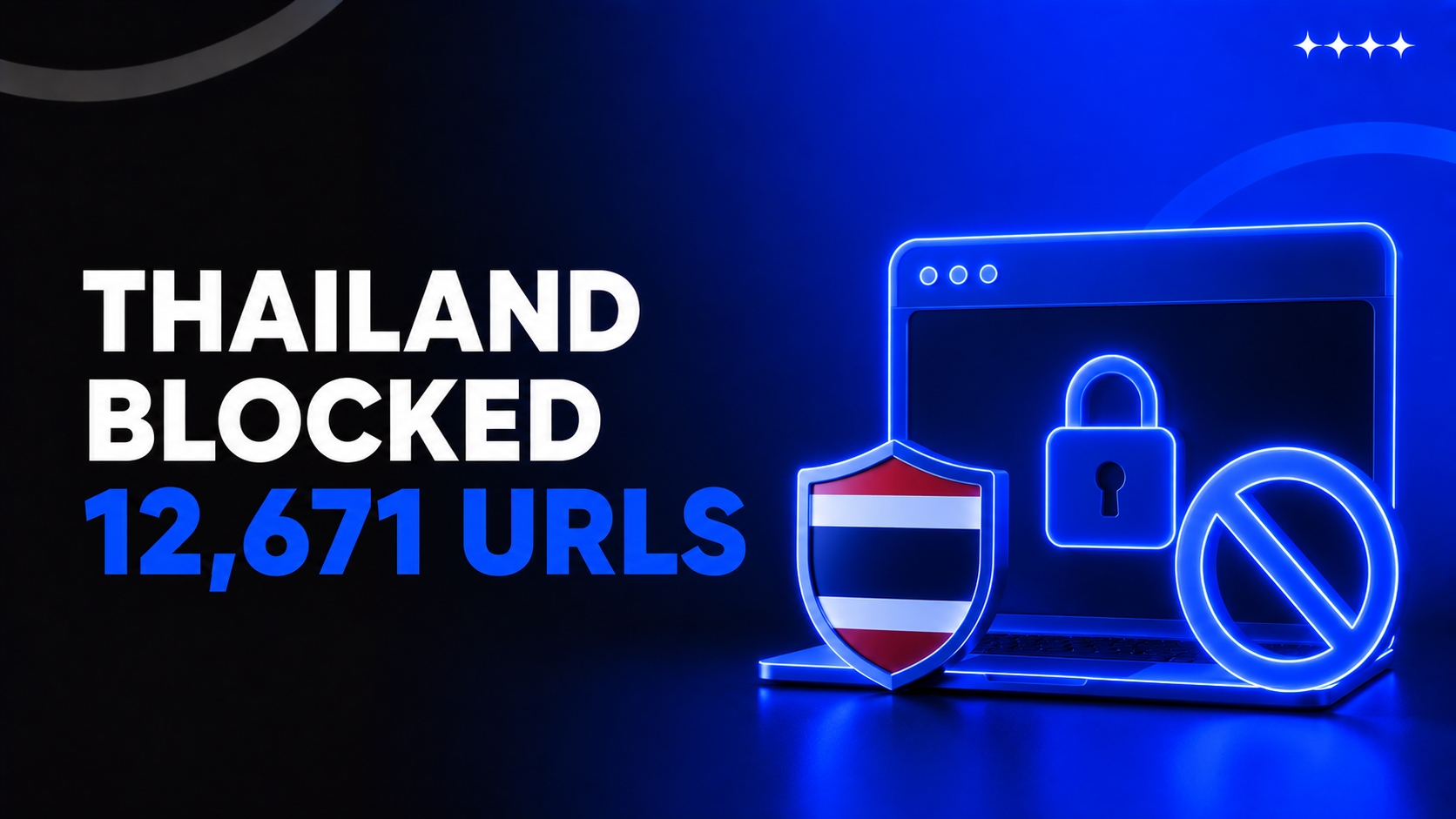
Between 10 and 24 June 2026, Thailand's Ministry of Digital Economy and Society (MDES) blocked 12,671 URLs tied to illegal online gambling and copyright infringement. The split is worth memorizing, because it tells you how the takedowns actually happen:
- 4,496 URLs were blocked under court orders — the slow, legally armored route.
- 8,175 URLs were removed through direct cooperation with the platforms themselves — Facebook, Instagram, X and YouTube pulling content on request.
That two-week sprint sits on top of a much larger campaign. From October 2025 through May 2026, Thai authorities blocked roughly 717,000 gambling-related links across websites, Facebook, Line and TikTok. In the first 18 days of June alone — as the FIFA World Cup 2026 kicked off — the ministry reported taking action against nearly 13,900 items, this time explicitly crediting AI detection for the speed.
The trigger is obvious: a World Cup is the single biggest betting event on the planet, and Thailand's government treats the tournament window as peak enforcement season. What's less obvious — and far more important if you make money sending traffic to offers — is how they're doing it and who they're starting to target.
This isn't a Thailand story. It's a template.
If you only watched Southeast Asia, you'd miss the pattern. The same enforcement model is being deployed on four continents at once, and the mechanics are nearly identical everywhere:
- Brazil flipped from "guidance" to full enforcement in early 2026. Working with telecom regulator ANATEL, the SPA had blocked more than 2,100 unlicensed gambling domains by March — and, crucially, ordered PIX, the country's dominant instant-payment rail, to refuse transactions to unlicensed operators. Blocking the domain is one thing; blocking the money is another.
- Argentina created a Specialized Gambling Prosecutor's Office and went a step further than most: it reclassified influencers and affiliates who promote illegal operators as "partners" of those operators, opening them to criminal liability. It also ordered app-store removals of unlicensed platforms.
- Europe is assembling a multi-jurisdiction coalition around what regulators openly call "infrastructure-level enforcement" — deliberately targeting the affiliates, payment processors and technical intermediaries that keep illegal operators online. A licensed affiliate network promoting an unlicensed brand can now draw coordinated scrutiny from several countries at once.
- Prediction markets (Polymarket, Kalshi) got hit with the same logic in over ten jurisdictions in 2026 alone — Spain, India, Indonesia, Argentina, Brazil and others — each ruling essentially the same thing: it's gambling, gambling needs a license, they don't have one, block it.
Read those together and the theme is unmistakable. Enforcement is moving up the supply chain — away from just the operator's front-end domain and toward everyone connected to it: the promoter, the payment path, the ad account, the hosting.
What actually changed under the hood
Three shifts make this wave different from the whack-a-mole blocking of past years.
1. AI has collapsed the detection timeline. Thai officials explicitly credit machine learning for scanning social platforms and flagging gambling content at a speed manual review never could. That matters to affiliates because the thing AI is trained to detect isn't just domains — it's behavioral and linguistic signatures: promo copy that mimics licensed brands, unusual domain clusters, irregular affiliate-traffic patterns. Your creative and your funnel structure are now part of the fingerprint.
2. Platform cooperation is the fast lane. Notice that in Thailand, two-thirds of takedowns came through the platforms, not the courts. Social networks increasingly remove flagged content on request without waiting for a legal order. If your distribution leans on Meta, X or YouTube properties, your exposure is a moderation decision, not a court date — which means it can vanish in hours with no appeal window.
3. The money is being cut off, not just the link. Brazil's PIX directive and Europe's payment-processor focus show regulators learning the obvious lesson: a blocked site with a working cashier just relaunches on a mirror. Choke the settlement layer and the whole funnel dies.
Why operators keep surviving — and what it costs
Enforcement looks overwhelming on paper, but the grey market adapts fast, and the adaptations tell you where the real pressure points are:
- Mirror domains. Block one URL and a clone appears within hours under a slightly altered name. In Brazil, industry analysis suggested a large share of "blocked" operators stayed reachable through redirects, Telegram links or tweaked domains. Blocking is a tax on operators, not a kill switch.
- VPN spikes. When access is restricted, users route around it. When Brazil briefly blocked X in 2024, VPN usage reportedly jumped over 1,000% in a day. Restriction changes how users arrive, not always whether they do.
- Financial re-routing. Thai police noted operators shifting from mule accounts toward corporate accounts, PayPal, cross-border intermediaries and crypto to stay ahead of payment-level blocks.
None of that is a reason to feel comfortable. Each adaptation adds cost, fragility and legal exposure — and every one of those costs eventually lands on the affiliate whose links, domains and ad accounts sit closest to the surface.
The part that matters if you run ads for a living
Strip away the geopolitics and here's the operational reality for webmasters, SEO teams and media buyers in 2026.
Your links are now evidence. Regulators like Switzerland's ESBK and others publish active ISP-level blocklists. Linking to a blocked domain — even indirectly, even through a redirect you forgot about — can put you in the crosshairs. Blocklist monitoring has quietly moved from "nice to have" to a standard operational task. Know what's on the lists in every geo you touch, and audit your own outbound links against them.
"Legal on paper" is a trap. In most licensing markets, a country being "legal" means legal for locally licensed operators only. Running an offshore brand into a market that looks open on paper is one of the most expensive mistakes in the business — and it's exactly the gap AI-driven enforcement is built to catch. Before you scale a geo, confirm the operator holds a local license there, not just an MGA or Curaçao badge.
Diversify distribution before you're forced to. If two-thirds of Thai takedowns run through platform cooperation, then any funnel over-reliant on a single social platform is one moderation sweep from zero. Spread across owned domains, email, push, native and search so a single takedown dents revenue instead of erasing it.
Build domain and infrastructure redundancy — the legitimate kind. This isn't about dodging law enforcement; it's basic business continuity. Redundant domains, clean and traceable payment pathways, documented affiliate terms with real oversight, and clear legal review across your stack. In the words of one industry compliance take: in this climate, being technically compliant isn't enough — you need to be verifiably above board at every level, because that's what protects you when an automated system flags your cluster.
Watch the promo language. AI models are being trained on the copy patterns of illegal operators — "quick wealth," aggressive urgency, imitation of licensed brand names. Creative that mimics those signatures raises your flag-probability even when the underlying offer is fine. Distinctive, compliant, brand-safe creative is now a risk-reduction tool, not just a CTR play.
Expect personal exposure to rise. Argentina's move to treat affiliates and influencers as operator "partners," and Europe's explicit targeting of intermediaries, signal the direction of travel. The era where the affiliate was too far down the chain to matter is closing.
Structure your entities, contracts and disclosures as if a regulator will one day read them, because in more geos every quarter, one will.
The bottom line
Thailand blocking 12,671 URLs in a fortnight is a big number, but the number isn't the story. The story is that enforcement has industrialized — court orders plus platform cooperation plus AI plus payment-rail blocking, aimed increasingly at the whole chain rather than just the operator's homepage — and that the model is being copied from Bangkok to Brasília to Brussels.
For anyone monetizing traffic in or near regulated verticals, the takeaway is uncomfortable but clarifying: the safest edge left is compliance, resilience and diversification. The affiliates who treat blocklists, licensing checks and clean infrastructure as core operations — not afterthoughts — are the ones who'll still be standing when the next World Cup rolls around and the enforcement machine spins back up.
Share this article
Send it to your audience or copy an AI-ready prompt.