Ranking Adult Sites in 2026: Google's Unwritten Rulebook for Webmasters Who Monetize Traffic

Running an adult site as a business in 2026 means playing a game where most of the rules are never printed anywhere. Google won't tell you outright how it decides whether your site thrives, stalls, or quietly vanishes from results — but the patterns are visible if you know where to look. Between the June 2025 explicit-content overhaul, the wave of age-verification laws that reshaped the market, and the AI-driven changes rippling through search, the operating environment looks nothing like it did even two years ago.
This is a practical breakdown of what actually moves rankings for adult sites now, what permanently caps your ceiling, and — because you're here to make money, not just to rank — how to keep the business alive when a single channel can be pulled out from under you.
The ceiling you can't remove: SafeSearch
Before any tactic matters, accept the structural limit. SafeSearch is on by default across most devices, and for a large slice of users it can't be turned off at all. School networks, corporate devices, shared family accounts, under-18 accounts, and many mobile carrier configurations lock it in place. Those users will never see your pages, no matter how well you optimize.
That means your addressable audience is capped before you write a single title tag. SafeSearch works through several layers at once: automated systems that scan the text, images, and video on your pages; machine-learning classifiers that keep getting better at detecting explicit material; and user reports that flag content. Even in the softer "blur" mode rather than a hard "filter," Google's ranking systems still actively suppress explicit results when a query doesn't clearly ask for adult content. Intent is weighed heavily — if the search isn't unmistakably adult, you don't appear.
The practical takeaway for a business owner: no SEO trick overrides this. Your organic traffic comes only from users who have deliberately switched filtering off. Because that pool is finite, two things follow. First, every ranking position for those users is worth more than an equivalent position in a mainstream niche. Second — and this is the part most operators underweight — you cannot build a durable business on this one capped channel alone. We'll come back to that.
| SafeSearch setting | Your visibility |
|---|---|
| OFF | Full |
| BLUR | Limited |
| FILTER | Blocked |
| Enterprise / school network | Zero |
| Under-18 account | Zero |
What actually ranks adult sites in 2026
Google uses hundreds of signals, but for adult sites a handful carry disproportionate weight. Third-party analyses of Google's ranking factors converge on a rough hierarchy: content quality sits at the top (roughly a quarter of the weighting in several widely cited models), followed by keyword relevance in titles, backlinks, niche depth, user engagement, and trust signals, with mobile performance and everything else filling out the rest. Treat the exact percentages as estimates, not gospel — but the ordering is consistent across sources and matches what operators see in practice.
There is a persistent myth worth killing: Google does not penalize a site simply for being adult. What it does is hold adult sites to a stricter quality bar, because this niche has historically attracted more spam, malware, cloaking, and deceptive monetization than most. Thin content, keyword stuffing, spammy link profiles, and aggressive interstitials hurt an adult site faster and harder than they'd hurt a mainstream one. Google's spam systems watch this category more aggressively for black-hat behavior.
A few benchmarks from public studies that are useful for calibration:
- Top-ranked pages tend to have several times more backlinks than the pages ranked just below them — link authority still separates the leaders from the pack.
- First-page results skew long; content studies routinely put the average well above a thousand words, which is a signal that depth and coverage matter even in a niche people assume is purely visual.
- Largest Contentful Paint under 2.5 seconds remains the performance line you want to stay under.
The lesson isn't "write 1,500 words on every tube page." It's that Google rewards pages that genuinely satisfy the query — accurate categorization, useful metadata, and content that matches intent — and punishes pages built only to farm impressions.
The June 2025 explicit-content overhaul (and the December 2025 refresh)
This was the most consequential change for the niche in years, and it's still the baseline everyone operates against. In mid-2025, Google updated its ranking systems to specifically demote sites that host explicit videos but block Googlebot from fetching the video files. Google's own guidance was blunt: these sites can expect a significant drop, especially in Video results. In December 2025, Google refreshed the explicit-content documentation again, tightening the best-practice language around moderation, CSAM/non-consensual-content prevention, and what to do if your site is wrongly flagged.
The core shift is philosophical: transparency replaced hiding. If you wall your explicit media off from the crawler, Google increasingly assumes the worst and either can't rank the page or misclassifies the whole property as explicit. Here's what that means in concrete terms.
1. Let the bot crawl — without dropping human age gates. The requirement is not "remove your age gate." It's "verify Googlebot and serve it the content without the gate, while still gating human users." Sites that kept blocking the crawler saw steep visibility losses. If Googlebot can't fetch your image and video bytes, it can't rank those pages for the queries they should win.
2. Separate explicit content by domain or subdomain, not just by folder. Google now prefers domain/subdomain separation over directory-level separation. Grouping explicit material this way stops a few pages from dragging your entire property into the "explicit" bucket and out of SafeSearch-on results.
3. Tag explicitly. Use appropriate rating metadata on explicit pages, and set <video:family_friendly>no</video:family_friendly> in your video sitemap entries for the explicit videos only. This tells Google exactly which content to hide when SafeSearch is on — which, counterintuitively, protects your non-explicit pages from being over-filtered.
4. Moderate user-generated content actively. Comments, uploads, and community sections that slip explicit material through can shift how your whole domain is classified. Google explicitly recommends publisher verification, content-moderation processes, and industry-standard techniques like hash matching and classifiers to catch violative material before it becomes your problem.
| Pre-2025 habit | 2026 rule | What to do |
|---|---|---|
| Block bots in robots.txt | Allow full crawl | Update robots.txt, verify Googlebot |
| Directory separation | Subdomain / domain separation | Migrate explicit content |
| Age gate for everyone incl. bots | Bypass gate for verified bots only | Implement bot detection |
| Optional meta tagging | Required tagging | Add rating meta + sitemap flags |
The new survival layer: age verification in 2026

This is the section the original conversation about "ranking" tends to ignore — and it's now the single biggest threat to an adult site's revenue, arguably bigger than any algorithm update. Ranking well does nothing if you're legally blocked from serving the users you rank for.
The regulatory landscape hardened dramatically through 2025 and into 2026:
- United Kingdom. The Online Safety Act's age-assurance requirement took full effect on 25 July 2025. Ofcom demands "highly effective" age assurance — photo-ID matching, facial age estimation, open-banking checks, or mobile-operator verification. A date-of-birth box or an "I am 18" checkbox no longer qualifies. Penalties run up to £18 million or 10% of global turnover, and Ofcom can order ISPs to block non-compliant sites. The market impact was immediate: major operators reported large UK traffic drops, and some pulled new UK registrations entirely rather than comply.
- United States. By early-to-mid 2026, more than 25 states had enacted age-verification requirements for adult sites, some extending to social platforms. The Supreme Court upheld state authority to impose these rules under intermediate scrutiny, which removed the "we'll wait out the legal challenge" strategy operators had leaned on. California's device-level approach (verify once when an account is created on a device) points toward where the architecture is heading.
- European Union. Age assurance is being folded into Digital Services Act obligations, with a privacy-preserving "prove you're over 18 without revealing your birth date" model tied to the EU Digital Identity Wallet. Several member states are piloting a shared verification app in 2026. France's regulator brought its rules into force in January 2026.
- Australia and others continue to tighten, with some operators choosing to geo-block entire countries rather than build compliant flows.
Why this belongs in an SEO article: the theme running through every framework is privacy-preserving, "highly effective" verification — and the way you implement it directly affects both Googlebot access and conversion. If your verification wall blocks the crawler, you lose rankings (see the June 2025 rules above). If it's clumsy for users, you lose conversions and revenue at the door. The winners in 2026 build verification that (a) lets verified bots through, (b) uses facial estimation, digital wallets, or zero-knowledge proofs instead of hoarding uploaded passports, and (c) keeps friction low enough that real users don't bounce. Compliance is no longer a legal side-quest; it's now part of your traffic and revenue stack.
Core Web Vitals for media-heavy sites
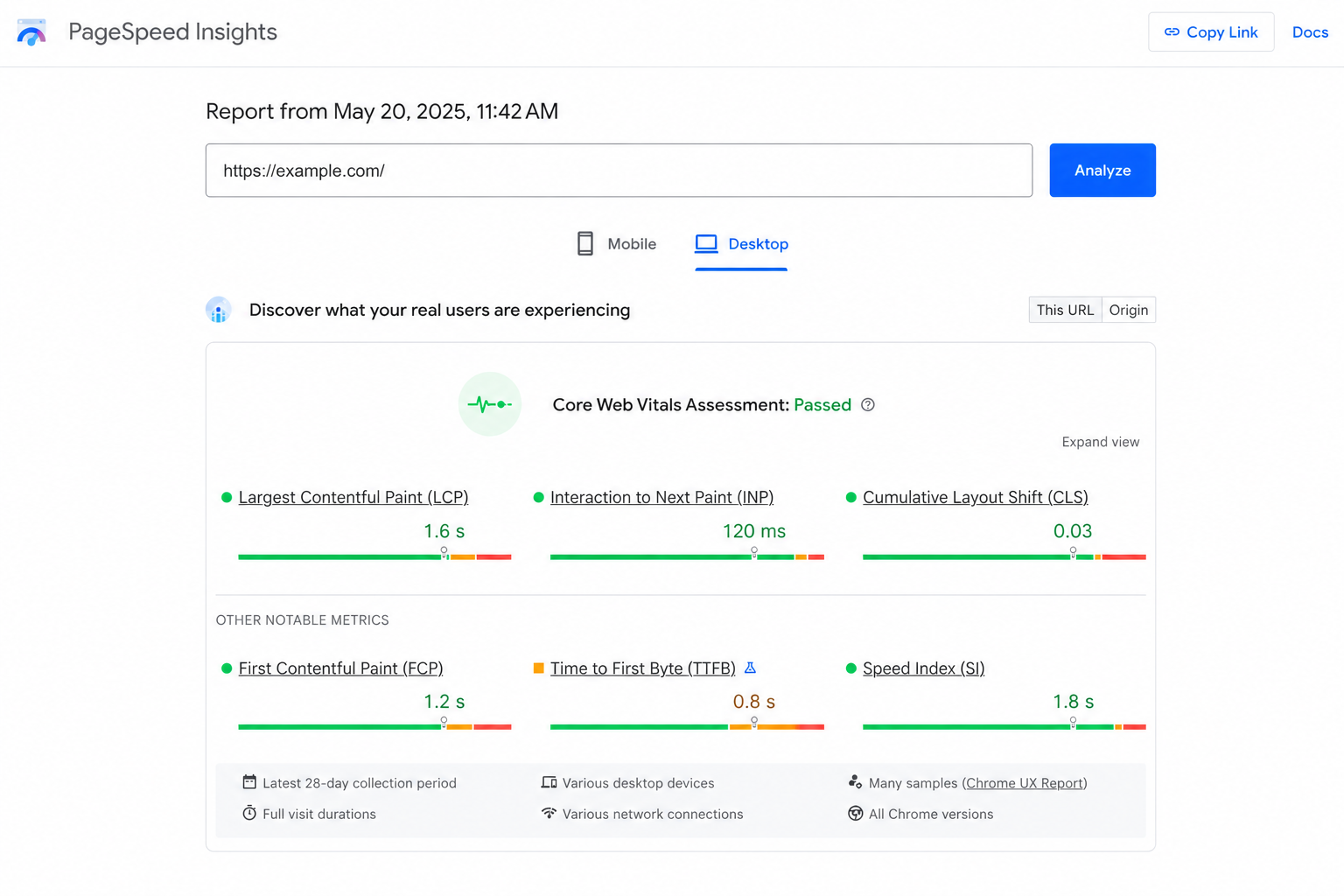
Page experience matters more each year, and adult sites carry a structural handicap: heavy video, large thumbnail galleries, and ad-dense layouts. The thresholds you're aiming for haven't moved and are worth memorizing:
| Metric | Good | Needs work | Poor |
|---|---|---|---|
| LCP (loading) | ≤ 2.5 s | 2.5–4.0 s | > 4.0 s |
| INP (interactivity) | ≤ 200 ms | 200–500 ms | > 500 ms |
| CLS (visual stability) | ≤ 0.1 | 0.1–0.25 | > 0.25 |
| TTFB (server response) | ≤ 800 ms | — | — |
Most adult sites fail these for predictable reasons: autoplaying video, unoptimized thumbnails, too many ads above the fold, and layout shifts from ads that load late. The fixes are equally predictable and worth the engineering time because they compound with everything else:
- Serve video through a proper CDN with global coverage — your audience is worldwide, and users in distant regions bounce on slow loads.
- Move images to WebP/AVIF and lazy-load anything below the fold.
- Reserve space for ad slots so late-loading creatives don't shove content around (kill the CLS).
- Interrogate your video player — clunky player interactions are a common INP killer.
The large incumbents pour serious money into exactly these optimizations, which is part of why they hold the top spots. You don't need their budget to hit the thresholds; you need to stop shipping the four mistakes above.
E-E-A-T and trust signals for adult content
Experience, Expertise, Authoritativeness, and Trustworthiness apply here too — you just demonstrate them differently than a finance or health site would.
- Experience shows up as original content, exclusive performers, and production quality Google can distinguish from the mass-produced sameness it has been actively demoting. The 2026 core updates leaned hard on devaluing content created mainly to scale traffic without adding anything new — a direct warning to sites built on scraping or aggregation.
- Expertise, for a tube or directory site, is accurate categorization, clean metadata, and content that matches what the user actually searched for. For creator platforms, it's verified profiles and authentic engagement.
- Authoritativeness is brand recognition, consistent quality, and a clean reputation. Sites drowning in DMCA takedowns or hosting non-consensual material take severe authority hits.
- Trustworthiness is HTTPS everywhere, a clear privacy policy, secure and legitimate payment processing, and transparent age verification. Google weighs user-safety signals heavily in this category specifically.
One signal deserves special attention because it operates at the site level, not the page level. Google has stated that a high volume of valid removal requests against a site is used as a quality signal for the whole property. In plain terms: if your site accumulates DMCA takedowns or non-consensual-content reports, the damage isn't limited to the removed URLs — it suppresses your rankings across the board. For a business, that reframes content moderation and rights management from a legal chore into a ranking-protection strategy.
Link building inside a closed ecosystem
Backlinks remain a top-tier factor, and adult sites face a structural problem here that mainstream sites don't. Most legitimate publications won't link to adult content. Guest posting on mainstream outlets is effectively off the table. Social platforms ban the material outright. That corners you into adult-to-adult linking — a comparatively closed ecosystem that Google can identify and discount more easily than a natural, diverse link graph.
The answer isn't volume; it's quality and relevance. Google representatives have repeatedly stressed that the relevance and quality of links matter far more than raw count — one link from a trusted industry publication outweighs hundreds of directory or forum links. Practical priorities:
| Link type | Value | Difficulty |
|---|---|---|
| Industry publications | High | Moderate |
| Genuine news coverage | High | Hard |
| Quality directory listings | Medium | Easy |
| Forum signatures | Low / none | Easy |
| Blog-comment links | None | Easy |
| PBN links | Risky | Moderate |
Chase real relationships with industry blogs, review sites, and publications; capitalize on PR whenever legitimate industry news breaks; and treat low-effort link tactics as, at best, a waste of time and, at worst, a spam-signal liability. In a niche this scrutinized, a manipulative link profile is a fast way to invite a spam action.
Technical must-haves (non-negotiable)
These are baseline, not optional. A site missing them isn't under-optimized — it's invisible.
- HTTPS on every page, not just checkout. Browsers flag plain HTTP as "Not Secure," and it's a confirmed ranking signal.
- Mobile-first everything. Google indexes the mobile version; most adult traffic is mobile; a weak mobile experience drags down desktop rankings too.
- Clean, descriptive URLs.
/category/video-titlebeats/?id=12345for both users and crawlers. - XML sitemaps with video tags, including the
family_friendlyflag on explicit entries. - Structured data. Adult pages won't earn rich snippets, but schema still helps Google parse your content structure.
- Global CDN. Your audience is worldwide; without one, distant users get slow loads and bounce.
What adult sites can never touch — and the overlooked upside
No matter how clean your SEO, adult content is permanently locked out of several surfaces: rich and featured snippets, Google Discover, the AI Overviews and AI Mode answers now dominating mainstream search, Knowledge Panels for explicit topics, and Google Ads. Organic search with SafeSearch disabled is effectively your only Google channel. There is no paid backup, no viral social lever, no featured placement to bail out a weak organic month.
That sounds purely like a disadvantage, and mostly it is — but there's a counterintuitive upside in 2026. The biggest story in mainstream SEO this year is AI Overviews and AI Mode absorbing clicks: position-one click-through rates on many mainstream queries have collapsed as Google answers questions directly above the results. Adult queries are excluded from those AI surfaces. So while mainstream publishers watched AI cannibalize their traffic, adult organic results were not being siphoned off by an answer box. The channel is capped and fragile — but on the queries you can rank for, a top position still delivers the click in a way it increasingly doesn't for mainstream informational content. That's a small structural advantage worth understanding, not squandering.
Don't build a business on one capped channel: traffic diversification
This is the part a pure ranking guide leaves out, and it's the part that determines whether you still have a business after the next algorithm update, the next age-verification law, or the next SafeSearch tightening. Google organic for adult is a capped, fragile channel. Treating it as your only revenue source is the single most common way profitable adult sites die.
Build redundancy across channels you actually control or influence:
- Alternative search engines. Bing (and everything that syndicates it) and privacy-focused engines have their own explicit-content handling and their own audiences. They're smaller than Google, but they're not subject to the same single point of failure, and optimizing for them is largely free once your fundamentals are solid.
- Direct and brand traffic. A memorable brand and a loyal audience that types your domain directly is the one channel no algorithm can suppress. This is why brand-building, retention, and email capture (where legally permissible) matter more here than almost anywhere else.
- Adult ad networks and media buying. The paid ecosystem Google shuts you out of has its own mature networks. For many operators this is the primary acquisition channel precisely because organic is capped.
- Affiliate and partnership traffic. The industry runs on affiliate relationships; a diversified inbound-partner mix insulates you from any one source drying up.
- On-site retention. Every visitor you convert into a returning user is a visitor you don't have to re-acquire through a fragile channel. Retention is a traffic strategy, not just a UX nicety.
The mental model: rankings are for acquiring traffic on a capped channel; brand, retention, and channel diversity are what turn that traffic into a durable business. Operators who internalize this survive the shocks that wipe out single-channel competitors.
If you get filtered or your rankings drop: diagnosis and recovery
Because misclassification is a real and recurring risk in this niche, know how to respond before it happens.
- Confirm what actually dropped. Separate a ranking loss (you fell in the results) from a filtering event (you're gone for SafeSearch-on users) from an AI-era traffic loss on your non-adult properties. Search Console impressions and position data tell you which — not raw analytics traffic, which conflates everything.
- Check crawlability first. After the June 2025 rules, the most common self-inflicted wound is blocking Googlebot from explicit media. Verify Googlebot is being served content without the age gate, and that robots.txt isn't walling off your video directories.
- Audit classification. If non-explicit pages are being treated as explicit (or vice versa), fix your domain/subdomain separation and your rating/sitemap metadata. Google's documentation includes a path for reporting content that's been incorrectly flagged as explicit — use it.
- Review your removal-request history. A spike in valid DMCA or non-consensual-content complaints suppresses the whole site. Get moderation and rights management under control; the ranking recovery follows the cleanup.
- Look for quality and scaled-content exposure. If a broad core update coincided with your drop, the issue is likely thin, duplicative, or mass-produced content. Consolidate and improve rather than publishing more of the same.
The 2026 action checklist
- Let verified Googlebot fetch all image and video bytes; keep human age gates.
- Separate explicit content by subdomain or domain, not just by folder.
- Apply rating metadata and
family_friendly=noflags to explicit content only. - Moderate all user-generated content; deploy hash-matching and classifiers for violative material.
- Implement "highly effective" age verification that passes bots, protects user privacy, and minimizes friction — per the jurisdictions you actually serve.
- Hit Core Web Vitals: LCP ≤ 2.5 s, INP ≤ 200 ms, CLS ≤ 0.1, TTFB ≤ 800 ms.
- HTTPS everywhere, mobile-first, clean URLs, video sitemaps, global CDN.
- Build a small number of high-quality, relevant industry links; avoid manipulative schemes.
- Keep DMCA and non-consensual-content exposure near zero to protect site-level authority.
- Diversify beyond Google: alternative search, direct/brand, adult ad networks, affiliates, and on-site retention.
- Monitor Search Console for filtering and classification issues; keep a documented recovery playbook.
Share this article
Send it to your audience or copy an AI-ready prompt.