ISP Proxies vs Residential Proxies: What's the Difference and Which Proxy Should You Choose?
Introduction
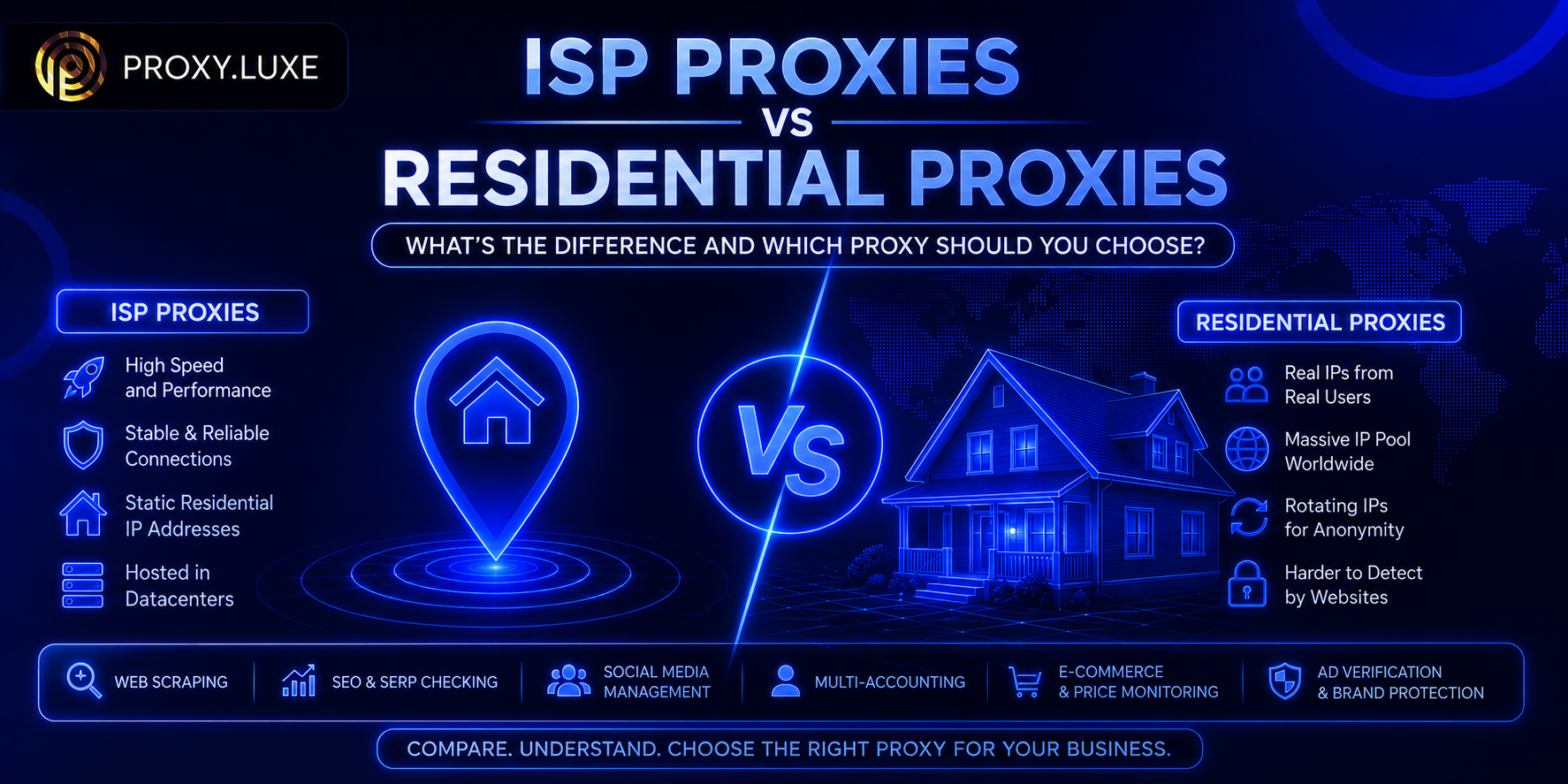
Choosing the right proxy solution is essential for anyone involved in web scraping, SEO, social media management, e-commerce, cybersecurity, or online automation. Among the many types of proxy servers available today, ISP proxies and residential proxies are two of the most trusted and widely used options.
At first glance, they appear very similar. Both use IP addresses assigned by Internet Service Providers (ISPs), both offer significantly higher trust scores than traditional datacenter proxies, and both help users avoid blocks and CAPTCHAs.
However, despite these similarities, ISP proxies and residential proxies are built differently and excel in different scenarios. Understanding these differences can save money, improve performance, and reduce the risk of detection.
In this guide, we'll explain how ISP proxies and residential proxies work, compare their strengths and weaknesses, and help you determine which proxy should you choose for your specific use case.
What Are Residential Proxies?
Residential proxies are proxy servers that route your internet traffic through IP addresses assigned to real residential devices by Internet Service Providers.
Unlike datacenter IPs, residential IPs belong to genuine households. As a result, websites recognize them as legitimate users browsing from home internet connections rather than automated servers.
Because of this, residential proxies have become the gold standard for tasks that require maximum anonymity and trust.
How Residential Proxies Work
When you connect through a residential proxy, your requests appear to originate from a real person's internet connection.
Depending on the provider, the IP address may belong to:
- a home broadband connection;
- a mobile internet subscriber;
- a residential gateway;
- a peer-to-peer proxy network.
Many providers also allow automatic IP rotation, replacing your IP after every request or after a predefined session length.
This rotating architecture makes residential proxies particularly effective for large-scale data collection.
Advantages of Residential Proxies
Highest Trust Score
Since websites see traffic coming from genuine residential users, residential proxies are much harder to detect than datacenter proxies.
Massive IP Pools
Leading providers maintain networks containing millions of residential IP addresses across virtually every country in the world.
Large IP pools significantly reduce the likelihood of rate limits and bans.
Geographic Flexibility
Residential proxies allow users to select:
- country;
- state or province;
- city;
- ZIP code (with some providers);
- ASN or ISP.
This makes them ideal for localized testing and market research.
IP Rotation
One of the biggest strengths of residential proxies is automatic IP rotation.
Instead of repeatedly sending requests from one address, every request can use a different residential IP.
This dramatically improves success rates during web scraping.
Better Anti-Bot Evasion
Modern anti-bot systems analyze dozens of factors, including:
- IP reputation;
- browsing behavior;
- ASN;
- request frequency;
- device fingerprint.
Residential proxies naturally pass many of these checks because they originate from legitimate residential networks.
Disadvantages of Residential Proxies
Although residential proxies offer outstanding anonymity, they also have limitations.
Higher Cost
Maintaining residential IP networks is expensive, making residential proxies one of the premium proxy solutions on the market.
Variable Speed
Traffic passes through residential internet connections rather than enterprise servers.
Connection speed may therefore fluctuate depending on the quality of the underlying network.
Rotating Sessions
Many residential proxy providers rotate IP addresses automatically.
While this is excellent for scraping, it isn't always suitable for long-term account management.
What Are ISP Proxies?
ISP proxies combine the advantages of datacenter proxies and residential proxies.
They use IP addresses officially assigned by Internet Service Providers but host them on powerful servers inside professional datacenters.
Because of this architecture, ISP proxies are often called static residential proxies.
To websites, these IP addresses appear to belong to regular residential internet users.
Behind the scenes, however, they benefit from enterprise-grade infrastructure.
How ISP Proxies Work
Unlike traditional residential proxies, ISP proxies do not route traffic through residential devices.
Instead:
- the IP address belongs to an ISP;
- the server resides inside a datacenter;
- the connection remains permanently online;
- bandwidth is significantly higher.
This combination provides excellent stability while maintaining a trusted IP reputation.
Advantages of ISP Proxies
Exceptional Speed
Because ISP proxies run on dedicated servers, they deliver significantly lower latency than most residential proxy networks.
For high-volume automation, this can make a considerable difference.
Stable Connections
ISP proxies are available 24/7 without relying on residential users being online.
This makes them highly reliable for business-critical operations.
Static IP Addresses
Unlike rotating residential proxies, ISP proxies usually provide a permanent IP.
Many online services actually expect users to connect from the same IP address over long periods.
Excellent Reputation
Since ISP proxies use legitimate ISP-issued addresses, they enjoy a much higher trust level than traditional datacenter proxies.
For many websites, they appear almost indistinguishable from residential users.
Disadvantages of ISP Proxies
Smaller IP Pool
Compared to residential proxy networks with millions of IPs, ISP proxy pools are usually much smaller.
Limited Rotation
ISP proxies are designed primarily for static connections.
If your project requires thousands of rotating IP addresses, residential proxies are generally the better solution.
Higher Cost Than Datacenter Proxies
Although ISP proxies are often less expensive than premium residential proxy services, they cost considerably more than standard datacenter proxies.
ISP Proxies vs Residential Proxies
The biggest difference between ISP proxies and residential proxies lies in where the traffic originates.
Residential proxies route traffic through real residential devices, while ISP proxies use datacenter infrastructure combined with ISP-issued IP addresses.
| Feature | ISP Proxies | Residential Proxies |
|---|---|---|
| IP Source | ISP-issued | ISP-issued |
| Infrastructure | Datacenter | Residential devices |
| Speed | Very High | Medium to High |
| Stability | Excellent | Depends on endpoint |
| Static IP | Yes | Optional |
| Rotating IP | Rare | Common |
| Large IP Pool | Limited | Massive |
| Detection Risk | Very Low | Extremely Low |
| Best For | Long-term sessions | Large-scale scraping |
These architectural differences explain why neither solution is universally better. The right choice depends entirely on your objectives.
Which Proxy Should You Choose?
After comparing the architecture and capabilities of both solutions, the next question is obvious: which proxy should you choose?
The answer depends entirely on your project requirements. Some tasks demand maximum anonymity and access to millions of rotating IPs, while others require stable, high-speed connections with a permanent identity.
Let's examine the most common use cases.
Best Proxy for Web Scraping
If your primary goal is collecting data from websites, residential proxies are generally the best option.
Modern websites use sophisticated anti-bot systems that monitor:
- IP reputation
- Request frequency
- Geographic consistency
- Browser fingerprints
- ASN information
- Behavioral patterns
Because residential proxies use genuine residential IP addresses, requests appear much more natural than traffic originating from datacenters.
For large-scale web scraping projects, rotating residential proxies significantly reduce the risk of:
- IP bans
- Rate limiting
- CAPTCHAs
- Temporary restrictions
This is why most professional web scraping proxies rely on residential IP networks.
However, if you're scraping a small number of websites that don't aggressively block automated traffic, ISP proxies can offer faster response times while maintaining a high level of trust.
Best Proxy for Social Media Management
Managing multiple social media accounts requires consistency.
Platforms such as:
- X (Twitter)
- TikTok
expect users to log in repeatedly from the same device, browser, and IP address.
In these situations, ISP proxies are often the superior choice.
A static residential IP helps establish a long-term digital identity that appears completely natural.
This makes ISP proxies particularly popular among users of:
- anti-detect browsers;
- social media agencies;
- affiliate marketers;
- digital advertising teams.
Best Proxy for SEO
SEO professionals frequently need to:
- monitor keyword rankings;
- analyze competitors;
- verify localized search results;
- audit Google SERPs;
- test geo-targeted content.
Because search results vary by location, residential proxies provide the greatest flexibility.
Many providers allow users to choose not only the country but also the city or even the ISP.
This makes residential proxies one of the best solutions for international SEO campaigns.
Best Proxy for E-commerce
Online retailers and e-commerce analysts often collect pricing information from:
- Amazon
- Walmart
- eBay
- Shopify stores
- AliExpress
- Best Buy
These websites actively detect automated traffic.
Residential proxies are generally the safest option for continuous price monitoring because rotating IP addresses reduce detection rates.
On the other hand, ISP proxies work extremely well for managing seller accounts or performing routine administrative tasks that require stable sessions.
Best Proxy for Account Management
If your business relies on long-term account usage, consistency is more important than IP rotation.
Examples include:
- Google accounts
- Microsoft accounts
- Amazon Seller Central
- Facebook Business Manager
- advertising platforms
- cryptocurrency exchanges
Here, ISP proxies offer significant advantages.
A dedicated static IP creates a stable online identity and reduces suspicious login activity.
Best Proxy for Automation
Automation software benefits from low latency and reliable uptime.
Because ISP proxies run on enterprise-grade servers, they typically provide:
- lower latency;
- higher bandwidth;
- faster response times;
- uninterrupted availability.
For automation tools interacting with trusted platforms, ISP proxies usually deliver superior performance.
If automation targets websites with aggressive anti-bot protection, residential proxies become the safer alternative.
ISP Proxies vs Residential Proxies: Pros and Cons
ISP Proxies
Pros
- Extremely fast connections
- Stable performance
- Static residential IPs
- Low latency
- Excellent for account management
- High trust score
- Reliable 24/7 availability
Cons
- Smaller IP pools
- Limited rotation
- Less suitable for massive scraping
- More expensive than datacenter proxies
Residential Proxies
Pros
- Millions of residential IP addresses
- Automatic IP rotation
- Outstanding anonymity
- Excellent success rate for scraping
- Wide geographic coverage
- Difficult for websites to detect
Cons
- Higher pricing
- Variable connection speed
- Session persistence depends on provider
- Not always ideal for long-term account management
Common Mistakes When Choosing a Proxy
Choosing Based Only on Price
Cheap proxies often come with poor IP reputation, overloaded infrastructure, or recycled addresses that have already been blacklisted.
Investing in higher-quality proxies usually results in better success rates and lower operational costs over time.
Ignoring Geographic Requirements
Many users purchase proxies before verifying whether the provider offers IPs in their target countries.
Always confirm available locations before making a purchase.
Using One IP for Multiple Accounts
Even the highest-quality ISP proxy can become suspicious if dozens of unrelated accounts use the same IP address.
Whenever possible, assign one dedicated proxy to each account.
Using Static IPs for Large-Scale Scraping
Attempting to scrape millions of pages from a single static IP is likely to trigger rate limits or bans.
Rotating residential proxies are specifically designed for this type of workload.
Frequently Asked Questions
What is the main difference between ISP proxies and residential proxies?
The primary difference lies in the infrastructure.
Residential proxies route traffic through real residential devices, while ISP proxies use ISP-issued IP addresses hosted on high-performance datacenter servers.
Are ISP proxies faster than residential proxies?
Yes. In most cases, ISP proxies offer lower latency, higher bandwidth, and more stable performance because they operate on enterprise-grade hardware.
Which proxies are harder to detect?
Residential proxies generally provide the highest level of anonymity because websites see requests coming from genuine residential internet connections.
Which proxy is better for long-term accounts?
ISP proxies are usually the best choice for long-term account management thanks to their static IP addresses and consistent connections.
Which proxy is better for web scraping?
For large-scale scraping projects, rotating residential proxies remain the industry standard because they minimize detection and maximize request success rates.
Can I use both proxy types together?
Absolutely.
Many companies combine both solutions:
- ISP proxies for account management and automation.
- Residential proxies for web scraping, SEO monitoring, and geo-targeted testing.
This hybrid approach often provides the best balance between performance and anonymity.
Final Verdict
There is no universal winner in the ISP proxies vs residential proxies debate.
Instead, the best solution depends on your specific objectives.
Choose ISP proxies if your priorities include:
- static residential IP addresses;
- high-speed connections;
- long-term account management;
- reliable automation;
- consistent online identity.
Choose residential proxies if you need:
- rotating residential IPs;
- large-scale web scraping;
- advanced anti-bot evasion;
- geo-targeting;
- maximum anonymity;
- access to millions of IP addresses worldwide.
For many businesses, the most effective strategy is combining both technologies. ISP proxies provide speed and stability for persistent sessions, while residential proxies deliver unmatched flexibility for data collection, market research, SEO, and global testing.
Before investing in any proxy solution, evaluate your project's scale, target websites, required locations, expected traffic volume, and security requirements. Choosing the right proxy infrastructure will improve performance, reduce detection rates, and help your online operations remain efficient and reliable over the long term.
Share this article
Send it to your audience or copy an AI-ready prompt.